VerifyPIN on Linux
The previous tutorials attack bare-metal software. Here the target is a VerifyPIN program, a classic benchmark for fault injection, running as a user program on Linux, on a VexRiscv SMP CPU. LiteInjector inverts a conditional branch of the PIN comparison so that a wrong PIN is accepted.
You need: a Digilent Arty-A7 100T board (Linux needs its DDR memory), a USB-UART adapter for the UART bridge, and the installation done. The files are in examples/poc_arty_linux.
Build the SoC and boot Linux
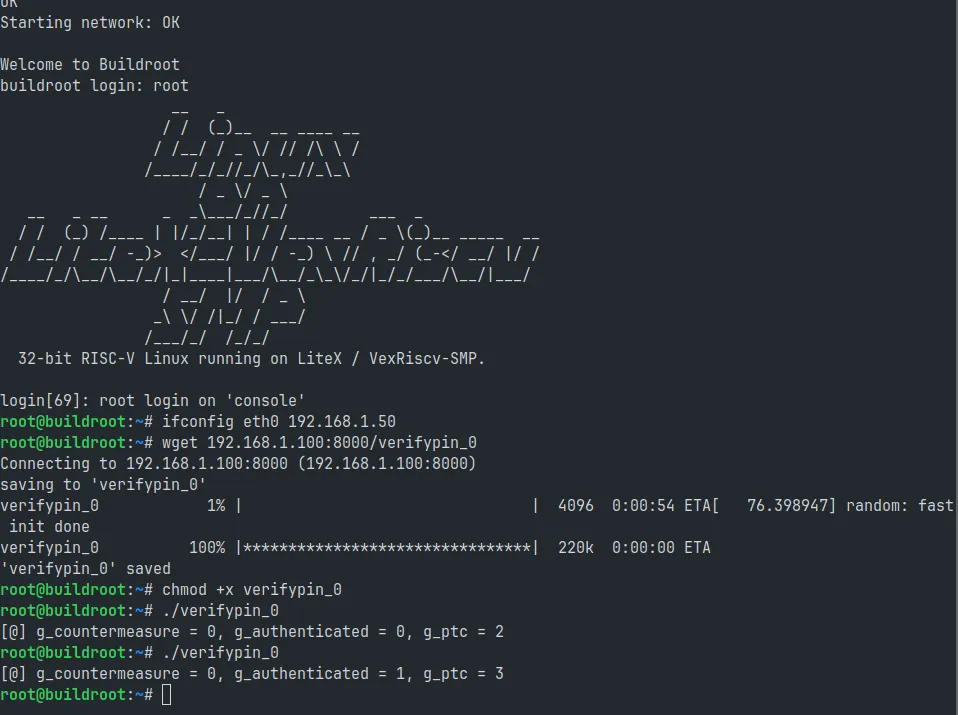
Section titled “Build the SoC and boot Linux”$ cd liteinjector/examples/poc_arty_linux$ ./digilent_arty.py --variant=a7-100 --cpu-type=vexriscv_smp --with-ethernet --with-wishbone-memory \ --csr-csv=csr.csv --csr-json=csr.json --build --load$ litex_term /dev/ttyUSB0 --images=images/boot.jsonThe Linux images (Image, rootfs.cpio, opensbi.bin) are in the images folder. Log in as root. The test programs can be uploaded to the board over the network, for example from an HTTP server on the host.
Find the target instruction
Section titled “Find the target instruction”The disassembly of the VerifyPIN program shows the conditional branch of the PIN comparison (bne a4,a5).
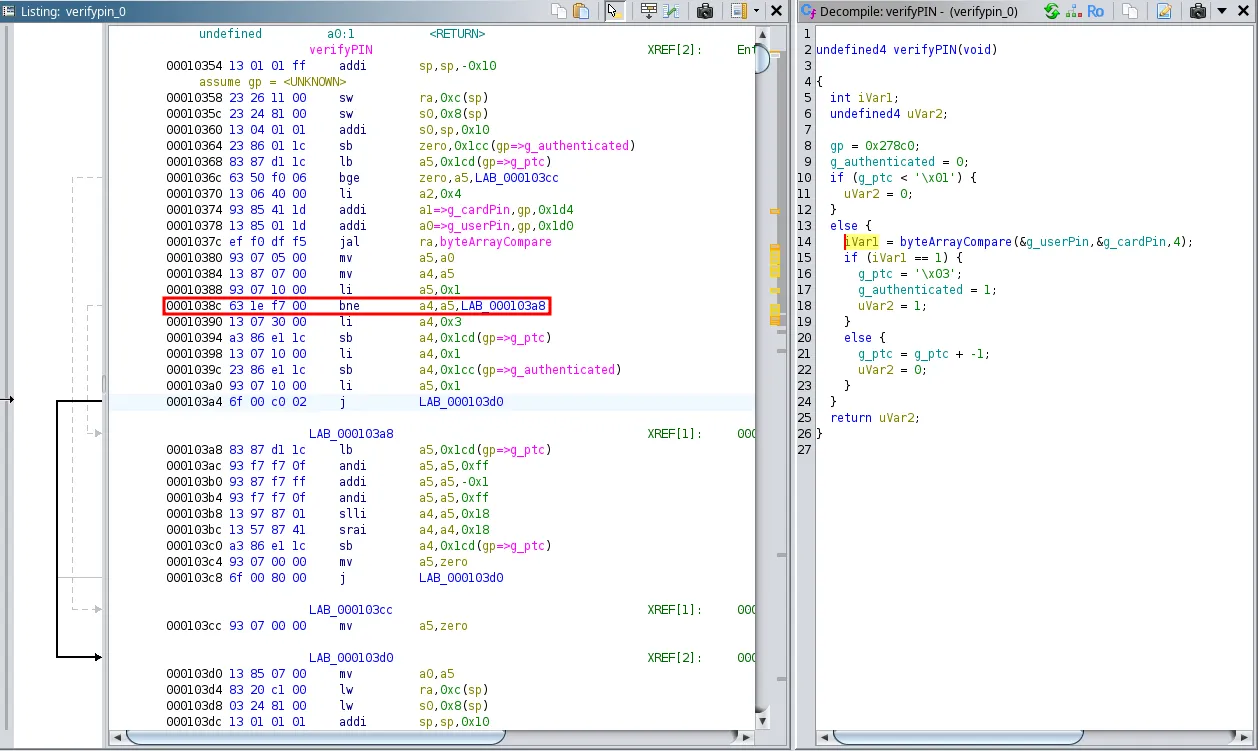
The program runs from virtual memory, so the full address depends on where Linux loads it, but its low byte stays the same: e3. The trigger therefore uses a value with “don’t care” digits on the address (0xxxxxxxe3), and also checks the instruction itself (0x00f71e63) to avoid faulting another instruction at a matching address. Resetting bit 12 of the instruction turns the branch into its opposite (0x00F70E63).
Attack
Section titled “Attack”-
Start
litex_serveron the UART bridge, in its own terminal.Terminal window $ litex_server --uart --uart-port /dev/ttyUSB1 -
Arm the emulator.
Terminal window $ liteinjector_cli run --when pbus_adr=0xxxxxxxe3 --when pbus_dat_r=0x00f71e63 \--fault bit-reset:pbus_dat_r:12 -
Run VerifyPIN with a wrong PIN.