Bypass PMP from the instruction bus
RISC-V Physical Memory Protection (PMP) lets the software forbid accesses to memory regions. In this tutorial, a program configures the PMP of a VexRiscv Secure CPU to protect a memory area, then tries to write to it: the write should be refused.
LiteInjector sits on the instruction bus and replaces the call to the PMP configuration function by a NOP. The protection is never set up, and the protected area can be written.

You need: a Digilent Basys3 board, a USB-UART adapter for the UART bridge, and the installation done. The files are in examples/poc_basys3_pmp_software.
Build the SoC and the program
Section titled “Build the SoC and the program”The program is compiled for the SoC, then loaded into its RAM with litex_term.
$ cd liteinjector/examples/poc_basys3_pmp_software$ ./digilent_basys3.py --cpu-variant=secure --csr-csv=csr.csv --integrated-main-ram-size=0x2000 --build --load$ cd software$ make Vex$ litex_term /dev/ttyUSB0 --kernel=poc.binThen use the serialboot command of the BIOS, or reset the board, to boot the program.
Find the target instruction
Section titled “Find the target instruction”The disassembly shows the call to the PMP configuration (pmp_set_region), and LiteScope gives the address where the CPU fetches it: 0x10000130.
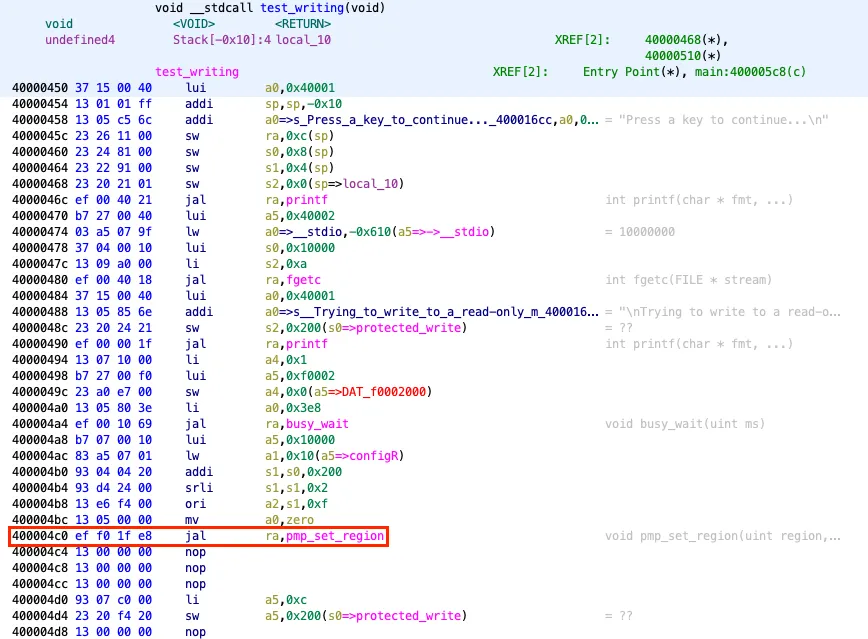
Replacing this instruction by 0x00000013 (NOP) skips the configuration.
Attack
Section titled “Attack”-
Start
litex_serveron the UART bridge, in its own terminal.Terminal window $ litex_server --uart --uart-port /dev/ttyUSB1 -
Arm the emulator, then boot the program.
Terminal window $ liteinjector_cli run --when ibus_adr=0x10000130 --offset 2 \--fault bit-value:ibus_dat_r=0x00000013
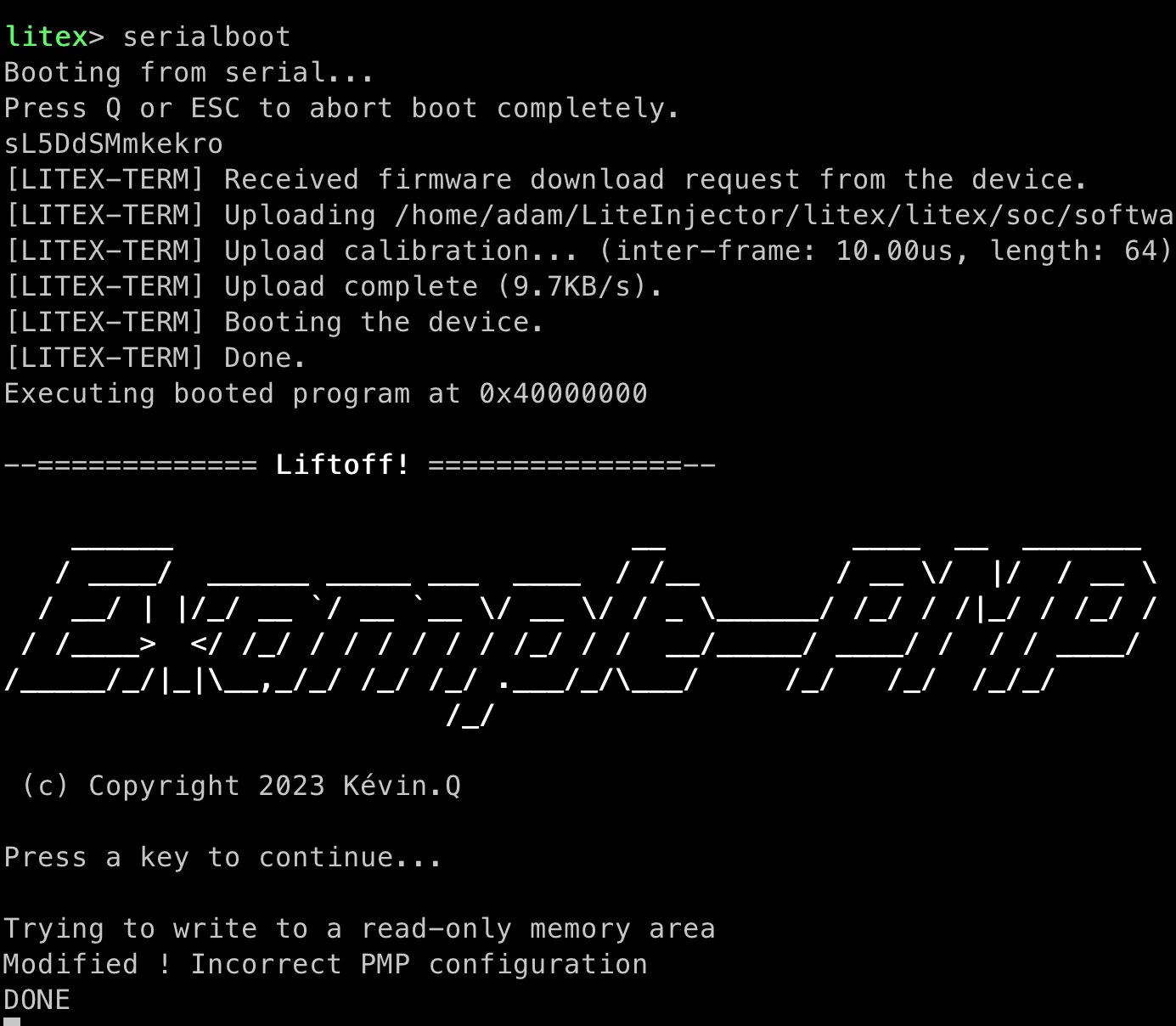
The program writes to the read-only area and the write succeeds.
The next tutorial attacks the same protection from inside the CPU.